How to Create a Calmer Transition from Work to Bed
One imagined working week, one small change a day: a closing-down list, moving the laptop, a short version for late nights, and a Saturday review.

On this page
For many people the working day does not end; it thins out. The laptop closes, but the phone still shows messages, and the last hour before bed is spent half-thinking about tomorrow. Healthdirect, Australia’s government health information service, recommends a “buffer zone” before bed in which you do no problem-solving and no planning for the next day. That is easy to agree with and hard to do.
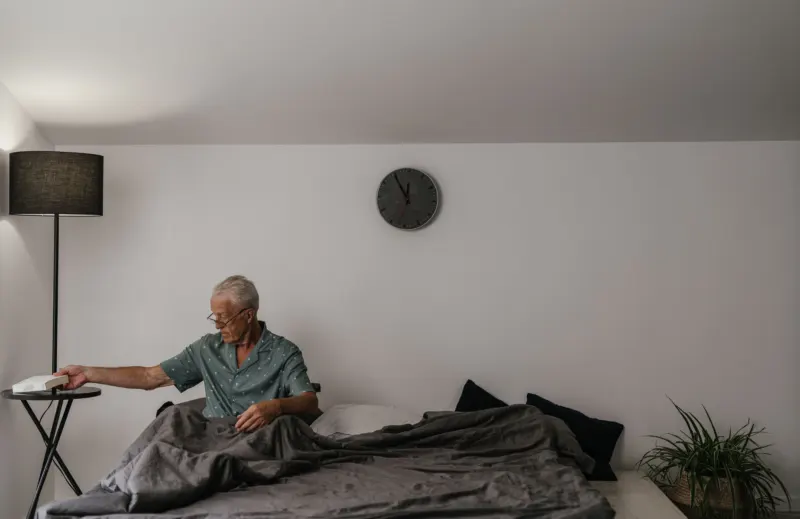
This article follows one imagined working week to show how a buffer can be built a piece at a time. The person is invented for illustration: someone who works at a laptop, often from home, usually stops around 9pm and aims to be asleep by 11.30pm.
The idea in brief
Three things carry work into the night: unfinished thoughts, the equipment itself, and light. The guidance addresses each. NHS Every Mind Matters suggests writing a to-do list for the next day if you tend to worry in bed. Healthdirect suggests keeping work tools and laptops out of the bedroom. The US National Heart, Lung, and Blood Institute (NHLBI) advises quiet activities in the hour before bed, away from bright screens, because light can signal the brain to stay awake.
The week below adds one of these each day.
Monday: watch what happens now
No changes yet. The only task is to notice when work really ends. On Monday our worker closes the laptop at 9.05pm, answers two messages on the phone at 9.40pm, checks the calendar in bed at 11.15pm, and lies awake until after midnight rehearsing a meeting.
Written down, the pattern is plain: work stopped three times, and the last time was in bed.
Tuesday: a closing-down list
At 8.50pm, ten minutes before stopping, the worker writes three things on paper:
- what is unfinished, in a line each;
- the first task for tomorrow morning;
- anything nagging that is not a task: a worry about a deadline, a conversation to have.
This is the NHS suggestion put into a fixed slot. The list is not for solving anything. Its job is to hold the items so they need not be carried around all evening. The paper stays on the desk.
Result on Tuesday: the calendar still gets checked once at 10pm, out of habit. That is fine. One change, imperfectly kept, is a normal first day.
Wednesday: move the equipment
The laptop has been living on the bedside table. On Wednesday it goes into a bag in the hallway once the closing-down list is written. Work notifications on the phone are silenced from 9pm using the phone’s scheduled do-not-disturb setting.
This follows healthdirect’s advice to keep work tools out of the bedroom, and its broader point that the bed should be linked in your mind with sleeping. In a one-room home, “out of the bedroom” becomes “out of sight from the bed”: a bag, a drawer, a cupboard.
Thursday: the night work runs late
A deadline pushes the finish to 10.45pm. This is the night most plans collapse, so it helps to have a short version ready.
The worker’s short version takes fifteen minutes: the three-line list, laptop in the bag, then a breathing exercise before brushing teeth. The NHS describes a simple one. Sit or lie comfortably, let your breath go as deep into your belly as is comfortable without forcing it, breathe in gently through your nose and out through your mouth, counting steadily from one to five each way if that helps, and keep going for at least five minutes.
Bedtime on Thursday slips to midnight. The worker still gets up at the usual time on Friday; the NHS advice on insomnia is to get up at the same time each day and not to sleep in after a poor night.
Friday: fill the gap with something
With work stopped at 9pm and the laptop away, there is now an empty stretch before bed, and empty stretches tend to refill with a phone. So Friday’s change is to decide what goes there. NHS Every Mind Matters lists reading, calming music, podcasts and meditation among its wind-down options; the NHLBI mentions a hot bath.
The worker picks two: a shower at 10.15pm and a novel from 10.45pm. Neither is special. They are simply different from work, and they happen in the same order.
The weekend review
On Saturday morning, five minutes with the week’s notes:
| Change | Kept? | Verdict |
|---|---|---|
| Closing-down list | 4 nights of 4 | Keep |
| Laptop in the hallway | 3 of 3 | Keep |
| Work alerts off at 9pm | 2 of 3 | Keep; add email app |
| Breathing exercise | 1 of 2 | Use on late nights only |
| Shower, then reading | 1 of 1 | Too early to say |
Notice what the review does not ask: whether sleep is now perfect. One week is too short to judge that. It asks which changes were realistic enough to survive a working week, because only those will still be in place in a month.
Adapting this to your own week
- If you finish at different times each day, tie the closing-down list to the end of work, whenever that is, not to the clock.
- If you are on call, silence everything except the on-call channel, and keep that device outside arm’s reach of the bed if your role allows.
- If the evening is the only time for chores or family, the buffer can be short. Fifteen minutes that reliably happen are worth having.
- If work spills over because the day has no pauses, the fix may lie earlier. See planning breaks into a busy working day and a realistic plan for a less rushed week.
Once a buffer exists, the steps in building a bedtime routine that fits your life show how to shape what goes inside it.
If worry about work is keeping you awake most nights for weeks, or you feel unable to cope, that is more than a scheduling problem. The NHS advises seeing a GP if changing your sleep habits has not helped, if the trouble has gone on for months, or if it is making daily life hard to cope with.
Sources
- healthdirect (Australian Government) (Australia) Sleep - stages, tips, disorders, apnoea
- NHS (UK) How to fall asleep faster and sleep better
- National Heart, Lung, and Blood Institute (NIH) (US) Sleep Deprivation and Deficiency - Healthy Sleep Habits
- NHS (UK) Breathing exercises for stress
- National Center for Complementary and Integrative Health (NIH) (US) Relaxation Techniques: What You Need To Know
- NHS (UK) Insomnia
How this guide was prepared
Written by Meetis Editorial with AI assistance, using the sources listed above, and checked against them before publication. It has not been reviewed by a doctor or other health professional. It is general information, not personal medical advice — for questions about your own health, speak to a qualified professional.